


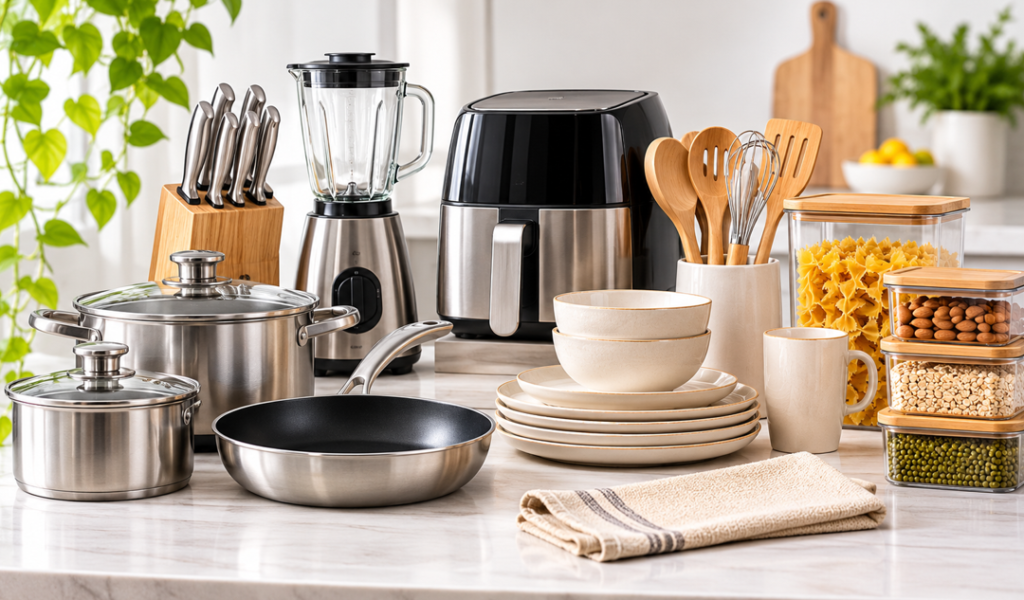
Creating a More Functional Home: Essential Kitchen and Household Products
The most useful kitchen is one that supports the meals you actually prepare. It does not need every appliance or an oversized cookware collection. A few well-chosen tools, clear work surfaces, and storage that matches your space can make daily cooking feel more manageable.
Before shopping, pay attention to the tasks that slow you down. Perhaps measuring tools are difficult to find, food containers never have matching lids, or an appliance occupies the only clear preparation area. Solving those specific problems is a stronger starting point than copying a display kitchen.
Map the way you use the room
Think through a typical meal from beginning to end: gathering ingredients, preparing them, cooking, serving, and cleaning up. Note where you move between tasks and which tools you reach for repeatedly. Keep the layout practical for everyone who uses the space.
A small kitchen may benefit from tools that serve several purposes. A larger one may need clearly defined storage areas so equipment does not disappear across multiple cabinets. The right approach depends on the available space and your cooking habits, not simply the number of products you own.
Build a core cookware collection
Start with the foods you cook most often. A frying pan, a saucepan, and a larger pot may cover many routine meals, but the useful sizes depend on household portions. Check the cooking surface diameter, capacity, and overall dimensions rather than judging scale from product photos.
Match cookware to your equipment
Read the cookware manufacturer’s information for stovetop compatibility, oven use, lid limitations, and care instructions. Do not assume that a pot works with every cooktop or that all components share the same temperature rating. Handles and lids may have separate restrictions.
Consider the weight when the cookware is full. A pan that feels manageable when empty may be awkward to lift with food inside. Storage also matters: make sure the item fits a cabinet or shelf without requiring an unstable stack.
Choose utensils you can maintain
Compare utensils by their intended tasks and compatibility with your cookware. A spatula’s edge, a spoon’s length, or a whisk’s shape may be more useful than a large matching set. Check material and heat-use instructions before bringing tools near a hot surface.
Cleaning requirements are part of the decision. Some items can go in a dishwasher, while others need hand washing or additional care. A tool that is difficult to clean after your usual recipes may not be a practical daily choice, even if it looks attractive on the counter.
Give appliances a realistic job description
For each appliance you are considering, name the tasks it will handle and how often you expect to use it. Compare that use with the preparation space, storage space, and cleaning time it requires. An appliance that is awkward to retrieve may be used less often than planned.
Check dimensions and included accessories
Measure the appliance’s intended location and read its clearance requirements. Consider access to doors, drawers, lids, and nearby outlets. Check which accessories are included and which are optional so you can compare the total purchase fairly.
Read the manufacturer’s setup and operating instructions, including electrical requirements and placement guidance. Follow those directions rather than improvising a location based solely on where the appliance fits. Keep the manual accessible for cleaning and troubleshooting.
Make food storage easier to manage
Start with the ingredients and leftovers you routinely store. Select container sizes that match those portions and fit the available shelves. A collection of matching lids can be helpful, but confirm that the containers suit their intended uses before buying a full set.
Check whether a container is intended for the freezer, microwave, or dishwasher, and follow any instructions about lids and temperature changes. Those features should come from the specific product information. Similar-looking containers may have different limitations.
Organize around frequency of use
Place frequently used tools where they are easy to retrieve and return. Less-used serving pieces can occupy a separate area. Keep sharp tools stored securely, and avoid arrangements that require reaching through a crowded collection to find one item.
Before buying organizers, remove items that no longer belong in the space and measure what remains. A drawer divider helps only if it accommodates the utensils you own. Bins that conceal everything may look tidy while making everyday supplies harder to locate.
Test changes one at a time
Try moving a frequently used tool closer to its work area before purchasing a new storage system. Rearrange one cabinet and use it for several meals. Small trials can reveal whether an idea actually makes cooking and cleanup easier.
Review the kitchen periodically as routines change. A household that starts preparing more lunches may need different containers, while someone cooking fewer large meals may prefer smaller cookware. Explore our Home & Kitchen category with those practical needs in mind.
Create a space that earns its keep
A functional home grows from thoughtful choices and usable routines. Buy for the meals, tasks, and space you have; confirm product compatibility; and leave enough room to work comfortably. The most valuable essential is the one that makes a recurring task easier and remains straightforward to care for.